The CIA Deer Gun was a single-shot, clandestine pistol developed in the early 1960s as a modern successor to the World War II FP-45 Liberator. Designed by Russell J. Moure of American Machine & Foundry (AMF), it was intended for distribution to South Vietnamese irregulars or guerrillas (possibly including Montagnard groups) to use against North Vietnamese or Viet Cong personnel during the early, more limited phase of U.S. involvement in Vietnam.
The concept followed the same "get a better gun" logic as the Liberator: fire one close-range shot to eliminate an enemy sentry or soldier, then take their weapon (typically an AK-47 or similar) and discard the disposable pistol. Chambered in 9x19mm Parabellum (chosen for wider ammunition availability compared to the Liberator's .45 ACP), it used a smoothbore barrel approximately 1.8–2 inches long. The receiver was cast aluminum, keeping weight around 12 ounces and overall dimensions compact (about 5 inches long). It had crude fixed sights consisting of a groove on a ramp.
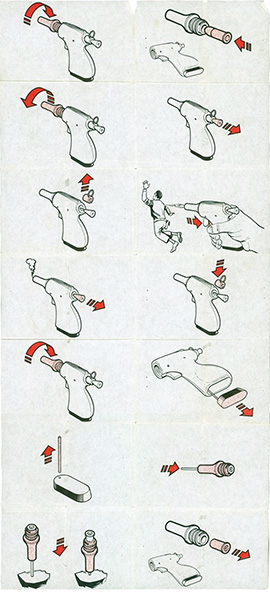
Operation was manual and minimalist; Unscrew the barrel to load a single 9mm cartridge into the chamber. Cock the protruding striker at the rear. Insert a small plastic safety clip around the striker to prevent accidental discharge (no mechanical safety otherwise). Screw the barrel back on. Remove the clip, aim, and pull the aluminum trigger (no guard) to fire.
The hollow grip stored three additional 9mm rounds plus a rod for pushing out spent cases during reloading. No markings of any kind appeared on the pistol to ensure deniability. Each unit shipped in an unmarked polystyrene (Styrofoam) box containing the pistol, three rounds of sterile 9mm ammunition (often headstamped "9 MM 42" or unmarked), and a pictographic instruction sheet showing operation.
Production totaled about 1,000 units in 1964, with a projected unit cost of $3.95 once tooled (roughly $40 in current dollars). Some limited evaluation occurred in Vietnam, but the escalation of the conflict into large-scale conventional warfare eliminated the need for such deniable, low-end arming tools. Most were reportedly destroyed, though a small number (estimates range from 10–25 surviving examples) exist in collections today, including specimens in the NRA Museum.
No evidence indicates integral suppression; it was a basic, unsuppressed single-shot design focused on extreme simplicity, light weight, and low cost rather than noise reduction. Velocity data is not well documented due to the short smoothbore barrel, but practical effective range was intended for contact distances only (a few meters), with the projectile's performance limited by the design.